

10th International Conference on Complex Networks & Their Applications

Date : 2021-11-30 => 2021-12-02
Lieu : Madrid

SPEAKERS
• Marc Barthélémy CEA France
• Ginestra Bianconi Queen Mary University of London UK
• João Gama University of Porto Portugal
• Dirk Helbing ETH Zürich Switzerland
• Yizhou Sun UCLA USA
• Alessandro Vespignani Northeastern University USA

TUTORIALS (November 29, 2021)
• Elisabeth Lex Graz University of Technology Austria
• Giovanni Petri ISI Foundation Italy

PUBLICATION
Full papers (not previously published up to 12 pages) and Extended Abstracts (about published or unpublished research up to 4 pages) are welcome.
• Papers will be included in the conference proceedings edited by Springer
• Extended abstracts will be published in the Book of Abstracts (with ISBN)

Extended versions will be invited for publication in special issues of international journals:
o Applied Network Science edited by Springer
o Complex Systems
o Computational Social Networks edited by Springer
o Network Science edited by Cambridge University Press
o PLOS one
o Social Network Analysis and Mining edited by Springer

TOPICS
Topics include, but are not limited to:
o Models of Complex Networks
o Structural Network Properties and Analysis
o Complex Networks and Epidemics
o Community Structure in Networks
o Community Discovery in Complex Networks
o Motif Discovery in Complex Networks
o Network Mining
o Network embedding methods
o Machine learning with graphs
o Dynamics and Evolution Patterns of Complex Networks
o Link Prediction
o Multilayer Networks
o Network Controllability
o Synchronization in Networks
o Visual Representation of Complex Networks
o Large-scale Graph Analytics
o Social Reputation, Influence, and Trust
o Information Spreading in Social Media
o Rumour and Viral Marketing in Social Networks
o Recommendation Systems and Complex Networks
o Financial and Economic Networks
o Complex Networks and Mobility
o Biological and Technological Networks
o Mobile call Networks
o Bioinformatics and Earth Sciences Applications
o Resilience and Robustness of Complex Networks
o Complex Networks for Physical Infrastructures
o Complex Networks, Smart Cities and Smart Grids
o Political networks
o Supply chain networks
o Complex networks and information systems
o Complex networks and CPS/IoT
o Graph signal processing
o Cognitive Network Science
o Network Medicine
o Network Neuroscience
o Quantifying success through network analysis
o Temporal and spatial networks
o Historical Networks

GENERAL CHAIRS
Rosa Maria Benito Universidad Politecnica de Madrid, Spain
Hocine Cherifi University of Burgundy, France
Esteban Moro Universidad Carlos III de Madrid, Spain

Lien direct


Notre site web : www.madics.fr
Suivez-nous sur Tweeter : @GDR_MADICS
Pour vous désabonner de la liste, suivre ce lien.
Anomaly Detection in Vessel Location Data for Coastal Security

Offre en lien avec l’Action/le Réseau : DOING/– — –

Laboratoire/Entreprise : Institut de recherche de l’école navale
Durée : 12 mois
Contact : cyril.ray@ecole-navale.fr
Date limite de publication : 2021-06-18

Contexte :
The ENDOUME project aims to design and develop a new solution to automatically secure a coastal maritime area. This innovative solution, based on machine learning algorithms but also rule-based analysis, meets various needs in terms of maritime security; sailing races, maritime events (e.g., G7 / G20, Cannes festival, nautical events, Olympic Games 2024…); port approaches, wind farms, marine protected area, etc.). The solution consists of (1) an autonomous coast station, comprising radar, optronic sensors and an AIS transponder, and (2) a set communicating beacons deployed on cooperative vessels connected through a resilient and secure radio network.

Under the umbrella of ENDOUME project, we aim to detect and prevent marine events such as intrusions into a controlled access area or unusual behaviors that may pose a risk on a maritime event (a focus on sailing races is considered) and its ecosystem (including onshore areas) by a continuous monitoring and understanding of marine movements.

Sujet :
The research to be addressed concerns the development of innovative analytical and learning algorithms combined with rule-based analysis supporting maritime security. The research will be organized by the different works to conduct:

– Definition, modelling or learning of regular behaviours, patterns, and unwanted movements.
– Preparation, annotation, curation of dataset (learning and scenario design).
– Design and implementation of rule-based and learning algorithms.

The research will be based on historical data provided by the Automatic Identification System which provide location of ships on a regular basis as well as nominative information. A data stream with a fusion of optronic sensor data, radar data and AIS data will be provided by project partners

Profil du candidat :
Post-doctoral researcher or research engineer in computer science / data science

Formation et compétences requises :
Good skills in machine learning and data analytics; knowledge in statistics and data fusion. Preferred programming language (Python, Java, C/C ++). Knowledge in databases and geographic information science is a plus. Speaking, reading, and writing in English

Adresse d’emploi :
Lanvéoc (Finistère)

Document attaché : 202106021249_Fiche de Poste ENDOUME 2021.pdf

PRESAGE: PREdicting Solar Activity using machine learning on heteroGEneous data

Offre en lien avec l’Action/le Réseau : – — –/– — –

Laboratoire/Entreprise : LIS / Université de Toulon
Durée : 34 months
Contact : adeline.paiement@univ-tln.fr
Date limite de publication : 2021-06-18

Contexte :
This postdoc position is part of the ANR-funded project PRESAGE: PREdicting Solar Activity using machine learning on heteroGEneous data. It concerns itself with the activity of the Sun, those events (e.g. flares, coronal mass ejections (CME)) are dynamical phenomena that may have strong impacts on the solar-terrestrial environment. Events of solar activity seem to be strongly associated with the evolution of solar structures (e.g. active regions, filaments), which are objects of the solar atmosphere that differ from the “quiet Sun” and which appear, evolve, and disappear over a period of days to months. The exact mechanisms of solar activity, and the links between solar structures and activity events, are still ill-understood.
Our project has three objectives related to solar physics, namely:
1) To improve our understanding of the mechanisms of solar activity
2) To enable the prediction of solar activity events such as flares, CMEs, radiation emission levels, and the fluxes of ionized particles likely to reach the Earth environment
3) To investigate the existence of typical temporal behaviours for 2D and 3D solar structures, i.e. filaments, active regions (AR), sunspots, and coronal holes
These objectives will be supported by two central objectives in machine learning (ML):
4) To develop new ML methods that can exploit the heterogeneous data generated by the many solar physics and space weather observation missions
5) To develop new ML algorithms that are guided by prior physics knowledge to increase their robustness and interpretability, and to reduce their need for large training datasets

Sujet :
The postdoctoral research will work with the PI and solar physics partners to develop physics-informed machine learning and deep learning methods for:
– 3D detection of solar structures
– Behavioural study of solar structures
– Prediction of solar activity events

Profil du candidat :
The candidate should:
– hold a PhD in machine learning, deep learning (DL), or computer vision
– have in-depth understanding of various DL models, and experience in creating new DL models
– have experience working with a wealth of data types including images and time series
– have experience with managing large datasets
An experience with multidisciplinary research (preferably with physics) would be desirable.

Formation et compétences requises :
– PhD in machine learning, deep learning (DL), or computer vision
– strong Python programming skills
– strong experimental skills, including the use of high performance computing clusters
– ability to work with and manage large datasets

Adresse d’emploi :
Laboratoire d’Informatique et Systèmes, équipe DYNamiques de l’Information (DYNI)

Université de Toulon, Campus de La Garde – La Valette, Avenue de l’Université, 83130 LA GARDE

2ème Webinar Action DOING – MADICS

Annonce en lien avec l’Action/le Réseau : DOING

Thème :

Transformation de données textuelles en information

Présentation :

L’action DOING MADICS (https://www.madics.fr/ateliers/doing/) vous invite à participer de son deuxième webinar 2021 !

DOING regroupe une communauté scientifique multidisciplinaire et ses Webinars sont organisés dans le but de promouvoir l’échange et le débat scientifique sur des thèmes ciblés entre différentes communautés. La réflexion sur des problèmes communs avec des perspectives diverses et des solutions complémentaires donnera lieu, nous en sommes convaincues, à des nouveaux projets, publications et actions scientifiques originelles.

Pour cette deuxième rencontre de l’année 2021, DOING propose un keynote et un groupe de travail plus centré sur la ‘transformation de données textuelles en information’.

Du : 2021-06-17 09:00

Au : 2021-06-17 13:00

Lieu : Zoom https://cnrs.zoom.us/j/94648003813
Code secret : VTi2Cg

Site Web : https://www.madics.fr/actions/doing/

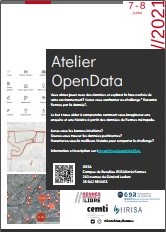
Raconter Rennes par la donnée

Annonce en lien avec l’Action/le Réseau : MADONA

Programme

Mercredi 7 juillet 9h30-20h30  
9h00 Accueil des participants
9h30 “La poule, le couteau et l’open data: quand les non-experts découvrent la réalité des données ouvertes”, Simon Chignard (Etalab)
10h00 “Défis de la réutilisation des données ouvertes et stratégies alternatives”, Samuel Goëta
10h30 “Data-journalisme : raconter des histoires grâce aux données”, Alexandre Léchenet (Data journaliste)
11h00 Pause
11h15 “Open Data à Rennes et projet Rudi”, Ben Lister (Rennes Métropole)
11h45 Présentation de l’action Madona et premiers résultats, Patrick Marcel (Univ. Tours)
12h00 Présentation et lancement de l’atelier

  • Objectifs de l’atelier
  • Présentation des participants et du dispositif
  • Mise en place des groupes et des thématiques
12h30 Pause déjeuner
13h30 Challenge pour les participants
17h30 Point d’étape des participants et apéro studieux pour ceux qui veulent prolonger
19h30 Fin de l’atelier
Jeudi 8 juillet  
suite du challenge (optionnel : il est tout à fait possible de n’assister qu’à la première journée)

Le challenge

Présentation

En une ou deux journées, vous explorerez les données publiées sur le site de l’Open Data de Rennes Métropole en vue de mener une enquête qui sera par la suite publiée. Selon le type de production, vous pourrez la publier dans votre média si vous êtes professionnel, sur le site de Rennes Métropole ou tout autre lieu approprié. La publication pourra être proposée sous forme de data visualisation contextualisée, d’article écrit ou de format plus créatif, visuel ou sonore.

Règlement

Le règlement du Challenge est disponible ici.

Remise du prix

A l’issue des deux jours, les participants devront partager leur narration avant le 11 juillet. Un jury composé de membres de Rennes Métropole, de journalistes et de scientifiques décernera le prix de la meilleure narration.

Les trois meilleures narrations seront récompensées.

Pour qui?

Public:

Cet atelier s’adresse à tous, professionnels, étudiants ou amateurs, intéressés par le traitement de données. Il n’est pas nécessaire d’être spécialiste de l’Open Data ou de connaître Rennes. L’objectif pour l’équipe organisatrice est de voir comment vous construirez une enquête et une narration pour restituer les résultats de cette enquête. Il n’y a pas de thème imposé, vous pouvez travailler sur l’éducation, les transports, la santé, etc.

Tout au long de l’atelier un responsable de Rennes Métropole et une équipe de data scientistes seront à vos côtés pour vous accompagner et vous aider à réaliser la meilleure enquête possible.

Participation en ligne:

Il est possible de participer à distance, il faut en revanche le signaler lors de l’inscription.

Inscription

L’inscription est gratuite mais obligatoire, à faire avant le 25 juin 30 juin : https://framaforms.org/inscription-au-challenge-raconter-rennes-par-la-donnee-1622456641

Compte-tenu du contexte sanitaire, il ne sera pas possible de déjeuner sur place mais nous nous efforcerons de maintenir à disposition de tous une table de rafraichissements pendant toute la durée de l’atelier.

Site Web de l’Action MADONA: http://www.madics.fr/actions/actions-en-cours/madona/

PostDoc position@L2S : Radioastronomy imager accelerated on FPGA through High Level Synthesis

Offre en lien avec l’Action/le Réseau : BigData4Astro/– — –

Laboratoire/Entreprise : L2S
Durée : 12 months (possibili
Contact : nicolas.gac@l2s.centralesupelec.fr
Date limite de publication : 2021-12-31

Contexte :
SKA computing, an HPC challenge The exascale radio telescope Square Kilometre Array (SKA) [1] will require supercomputers with high technical demands. The Science Data Processor (SDP) pipeline [2] in charge of producing the multidimensional images of the sky will have to execute in realtime a complex algorithm chain with data coming from telescopes at an incredible rate of several Tb/s and limited storage possibilities. The SDP will also have to be as green as possible with an energy budget of only 1 MWatt for 250 Petaflops.

FPGA as an alternative to GPU. Aside from the GPU mainstream architecture, alternative accelerators present better power-efficiency and cannot be already aside the road for the final SDP implementation. Among the alternative solutions, FPGA is an hardware architecture offering a unique fine-grain task and data parallelism compared to architectures based on processors like CPU, GPU or Kalray MPPA with a design dedicated to algorithms. However, the usual synthesis flows require hard- ware expertise and long implementation time. One of the promises of the emerging High Level Synthesis (HLS) tools is to make FPGA development accessible by software engineers with hardware implementa- tions generated from software programming languages like C, C++, or OpenCL. Afterwards, the FPGA design can be optimised gradually with the integration of hardware blocks. The dedicated FPGA solutions usually outperform GPU ones using the whole available computing power and avoiding memory congestion. First results obtained by the Astron Team for radioastronomy are already encouraging [3].

A collaborative work. This work will part of the ANR project, Dark-Era [4] which aims to : (i) build SimSDP, a rapid prototyping tool providing exascale simulations from dataflow algorithm descrip- tion, (ii) explore low power accelerators like FPGA or Kalray MPPA as alternatives to mainstream GPU architecture and (iii) be source of proposals for SKA computing and promoting french contribu- tions such as ddfacet [5]. Dark-Era gathers from the SimGrid [6] development Team at IRISA, the PREESM [7] development team at IETR, the inverse problem team at L2S, and two radio astron- omy teams at Observatories of Paris and Cˆote d’Azur. The inverse problems team (GPI) has a mixed expertise in architecture and signal processing with a long-term experience in deconvolution applied to astronomy ; On that topic, a PhD is in progress working on GPU acceleration in collaboration with Atos-Bull [8]. The GPI has driven research works on Intel FPGA acceleration through HLS tools since 2016 for tomography reconstruction, another inverse problem [9, 10].

Sujet :
PostDoc Goal. Exploration of the potential of FPGA acceleration with High Level Synthesis tools will be done through the design of an SDP prototype for NenuFAR [11] ; this very large low-frequency radio telescope located at Nan ̧cay Observatory has been inaugurated in Oct. 2019. It will produce visibility throughput about one hundred times lower than SKA1-LOW and adjustable to the single node prototype capabilities. The FPGA prototype will be designed through Intel FPGA SDK for OpenCL ; The FPGA prototype will be set up at Nanc ̧ay, connected to the correlator output visibility stream, to run in realtime its SDP pipeline. A main interest of this study is to deliver performance feedbacks in time, memory and energy to SimSDP. Indeed evaluation of the performance gain using FPGA inside HPC nodes in this specific use case, will be particulary useful to assess which role FPGA could play in future SKA like HPC projects.

Profil du candidat :
Candidate Profile.
1. PhD in computer science (or signal processing);
2. Experience in computing acceleration on FPGA (Intel or Xilinx) or GPU (Cuda/OpenCL);
3. Good background in signal processing;
4. Experience in publishing high quality research papers.

Formation et compétences requises :
*

Adresse d’emploi :
https://l2s.centralesupelec.fr/job/dark-era-postdoc/

Document attaché : 202105311255_postdoc_Dark-Era.pdf

Detection of adversarial examples in natural image databases

Offre en lien avec l’Action/le Réseau : – — –/– — –

Laboratoire/Entreprise : CEA Grenoble
Durée : 12 Months
Contact : marina.reyboz@cea.Fr
Date limite de publication : 2021-05-31

Contexte :
Artificial neural networks (ANNs) have become fundamental tools for processing data that is now massively exchanged. Their deployment in sensitive technologies (autonomous cars, smart grids, content filtering, pre-processing of personal data on the peripheral internet, etc. ) is accelerating. However, ANNs have a major security default: they can be attacked by adversarial examples. Adversarial examples are data created maliciously to lead ANNs to make erroneous predictions. They pose a critical problem today and are therefore a hot topic in machine learning.

Sujet :
A bio-inspired model has already been built to detect adversarial examples, which implements reinjections similar to those proposed in some computational models of human memory. The hybrid model implements both auto-encoder and classifier functions, gets of excellent performance on small-scale databases. A patent is being filed that will protect the system for the detection of anomalies in a broad sense. A scientific paper is also being written, which presents the model for the specific case of the detection of adversarial examples (which can be considered a particular case of anomalies), a particularly difficult to detec).
The postdoctoral researcher will be required to generalize the model’s performance to larger-scale natural image databases. In particular, it will be necessary to:
– Propose a new type of hybrid architecture to move from classic autoencoders to convolutional autoencoders (which would no longer require a pre-extraction of features);
– Test integration of the generative model system (which “stabilizes” the latent space), in particular variational autoencoders;
– Optimize the existing model parameters.
On the other hand, we would like to extend the topic of adverse case detection to the robustness of models against adversarial examples (i. e., the ability of models to properly classify adversarial examples). Preliminary results from smaller databases suggest that the reinjection of an adversarial example might help to identify its class of origin or to denoise it, a phenomenon that has yet to be quantified and generalized to larger databases.

Profil du candidat :
The candidate should have completed a PhD in Computer Science, Machine Learning.

Knowledges and experiences in some or all of the following fields will be an asset during the position:
• Adversarial Machine Learning
• Security (attacks, protections, evaluation)
• Applied mathematics (probability / statistics)

A brief description of the PhD thesis, a publication list and some recommendations should be included to your application.

Formation et compétences requises :
Good programming practice in Python (Tensorflow, with some basic GPU environment knowledges). Applicants should master written and spoken English.

Adresse d’emploi :
CEA Grenoble

Deep learning methods for sustainable development applications: decarbonization of buildings

Offre en lien avec l’Action/le Réseau : – — –/– — –

Laboratoire/Entreprise : CEA Grenoble
Durée : 24 Months
Contact : marina.reyboz@cea.fr
Date limite de publication : 2021-05-31

Contexte :
Heat pumps (HPs) are playing an increasing role in energy systems and have the potential to make a significant contribution to the decarbonization of the building sector. However, current HPs do not sufficiently take into account the variability of external disturbances such as weather conditions or user requirements.

Sujet :
The two main objectives of the project are the development of Artificial Intelligence (AI) methods based on the incremental learning of Artificial Neural Networks (ANNs) to achieve adaptive regulation and supervision of HPs. Indeed, ANNs can improve the energy performance of HPs by learning about their different modes of operation and allowing them to adapt their heat production in anticipation of future events, as well as by adaptive detection of operational anomalies. However, both ANNs and other machine learning methods often generate significant errors when confronted with significantly different or new data. For real-time use in HP regulators, the ANN system must constantly learn new knowledge, while keeping in mind the old ones.
Thus, this work will cover the development of the end-to-end AI pipeline for time series data based on incremental learning for adaptive HP control and supervision, with the development of AI pipeline based on incremental learning for numerical and event sequence data (generated by successive operational states of an underlying unknown state machine):
o Pre-process datasets
o Develop the classification and the forecast models
o Develop the anomaly and novelty detection model for the use cases
o Develop the incremental model to the defined datasets

Profil du candidat :
The candidate should have completed a PhD in Computer Science, Cognitive Sciences, Machine Learning, or Signal Processing. The main requirement of the candidate is to have strong skills in Neural Network modelling and be able to program a Convolutional Neural Network (CNN), Recurrent Neural Network (RNN) and Long-Short Term Memory (LSTM) Network.

Good programming practice in Python (Tensorflow, with some basic GPU environment knowledge). Applicants should master written and spoken English. A brief description of the PhD thesis, a publication list and some recommendations should be included to your application.

Formation et compétences requises :
Knowledges and experiences in some or all of the following fields will be an asset during the position:
• Deep learning / Machine Learning
• Applied mathematics (probability / statistics)

Adresse d’emploi :
CEA Grenoble

Post-doctoral position (18 to 24 months) at INRAE – UMR TETIS, Montpellier, France

Offre en lien avec l’Action/le Réseau : – — –/– — –

Laboratoire/Entreprise : UMR TETIS
Durée : 18 to 24 months
Contact : roberto.interdonato@cirad.fr
Date limite de publication : 2021-07-15

Contexte :
In recent years, the amount of data generated on human and animal health events has increased significantly. Epidemiologists must therefore regularly analyze these data with various spatial and temporal resolutions. The proposed postdoc contract is part of the H2020 MOOD project “Monitoring Outbreak events for Disease surveillance in a data science context” (https://mood-h2020.eu), which brings together 25 partners from 10 countries. This project is led by CIRAD (UMR ASTRE) and aims at improving the detection, monitoring and evaluation of emerging infectious diseases in Europe by using advanced data science techniques on massive multisource data.

The work package 3 “data ingestion and integration” is centered on the linking of heterogeneous data collected and processed in the context of the MOOD project. These data are heterogeneous in terms of domain (e.g., medical, environmental, social) and in terms of format (e.g., textual data, satellite imagery, multivariate quantitative data), and can be originated by both official (e.g., medical institutes, scientific laboratories) and unofficial (e.g., newspapers, social media) sources. By consequence, this diversity is also reflected in the spatial and temporal scales of the data.
More precisely, in the context of this post-doc, we are interested in modeling information about epidemiological events (detected from various data sources that are syntactically and semantically heterogeneous) into complex networks models that can allow advanced spatio-temporal analyses.

Sujet :
The postdoc is focused on the possibility to model the heterogeneous data collected and processed in the context of the MOOD project into advanced complex network models, i.e., networks that integrate spatial and temporal information about the data.
The objective is twofold: (i) to show how heterogeneous data about an epidemiological event can be integrated, aggregated and analyzed into complex network models in order to allow an analysis of the complex spatio-temporal phenomena that characterize the life cycle of an epidemic, and (ii) to define original networks analysis and data science techniques in order fully exploit the information modeled in such spatio-temporal networks.

The research question at the center of this postdoc can be formulated as follows: How can we relate spatio-temporal information from epidemic-related data in order to have a spatio-temporal analysis framework in the One Health context?
More precisely, we wish to propose generic methods to link and aggregate information from heterogeneous sources (in particular official and unofficial sources) into feature-rich networks able to embed spatio-temporal features, that will allow to analyze the life cycle of an epidemic according to its spatial and temporal evolution.
The final aim is then to bring new knowledge to experts, that will represent a precious complement to the classic source of information already exploited in the project. This spatio-temporal linking process will have to take into account some reliability and quality factors associated with the different descriptors, i.e., depending on source types and on the confidence of the algorithms in use.

Profil du candidat :
PhD in computer science.

Preference will be given to highly motivated candidates with research experience in complex network analysis, heterogeneous data science and data science applied to epidemiology related tasks.

Formation et compétences requises :
PhD in computer science.

Preference will be given to highly motivated candidates with research experience in complex network analysis, heterogeneous data science and data science applied to epidemiology related tasks.

Adresse d’emploi :
500 rue Jean François Breton, 34090, Montpellier

Document attaché : 202105251458_PostDoc MOOD 2021.pdf

Post-doctoral position on causal reasoning for time series

Offre en lien avec l’Action/le Réseau : – — –/– — –

Laboratoire/Entreprise : LIG
Durée : 21 mois
Contact : Emilie.Devijver@univ-grenoble-alpes.fr
Date limite de publication : 2021-06-30

Contexte :
Datasets structured as time series are available in many applications: provided by FMRI to study brain activity, summarizing the monitoring activity to detect IT anomalies, to name just a few of applications. However, as with any machine learning study, it is important to take into account the intrinsic causal structure to improve the decision as causal relations are crucial to predict the evolution of a system. If there have been several works dedicated to inferring causal graphs between time series (as [5]), few studies have been dedicated to causal reasoning and to the identification problem, which consists in computing, from data observed without any intervention, the probability of occurrences of events conditioned with variables forced to specific values.

Sujet :
[2] for example derived conditions of indeitification, comparable to the back-door and front-door criteria, from which they proposed a method to compute causal effects. However, their development concerns Granger causality [3], which does not correspond to true causal relations. More recently, [1] revisited Pearl’s original proposal [4] and developed algorithms for Dynamic Causal Networks (DCNs) with hidden variables. The objectives of this post-doctoral project is, first, to follow a similar approach to address the identification problem in the context of time series, and develop in this same context appropriate counterfactual reasoning procedures.

[1] G. Blondel, M. Arias, and R. Gavaldà. Identifiability and transportability in dynamic causal networks. Int J Data Sci Anal, 3:131–147, 2017.
[2] M. Eichler and V. Didelez. Causal reasoning in graphical time series models. In Proceedings of the Twenty-Third Conference on Uncertainty in Artificial Intelligence, UAI’07, page 109–116, Arlington,
Virginia, USA, 2007. AUAI Press.
[3] C. Granger. Some recent development in a concept of causality. Journal of Econometrics, 39(1-2):199–211, 1988.
[4] J. Pearl. Causal diagrams for empirical research. Biometrika, 82(4):669–688, 12 1995.
[5] J. Runge, P. Nowack, M. Kretschmer, S. Flaxman, and D. Sejdinovic. Detecting and quantifying causal associations in large nonlinear time series datasets. Science Advances, 5(11), 2019.

Profil du candidat :
Interested candidates should send a complete CV with a list of publications and two reference letters to Emilie Devijver (emilie.devijver@univ-grenoble-alpes.fr) and Eric Gaussier (eric.gaussier@univ- grenoble-alpes.fr). Candidates should be pursuing internationally recognized research in ML/AI, with a strong interest in causal inference and causal reasoning.

Formation et compétences requises :
This project fits within the Grenoble Computer Science Lab (called LIG, http://www.liglab.fr/en) and the Interdisciplinary Institute in Artificial Intelligence MIAI@Grenoble Alpes (https://miai.univ-grenoble- alpes.fr/). MIAI@Grenoble Alpes is one of the four AI Institutes created by the French government to accelerate R&D, teaching and innovation in AI in France.

Adresse d’emploi :
The work should take place on the University Campus in Grenoble, France.

Document attaché : 202105250639_postdoc_prop.pdf